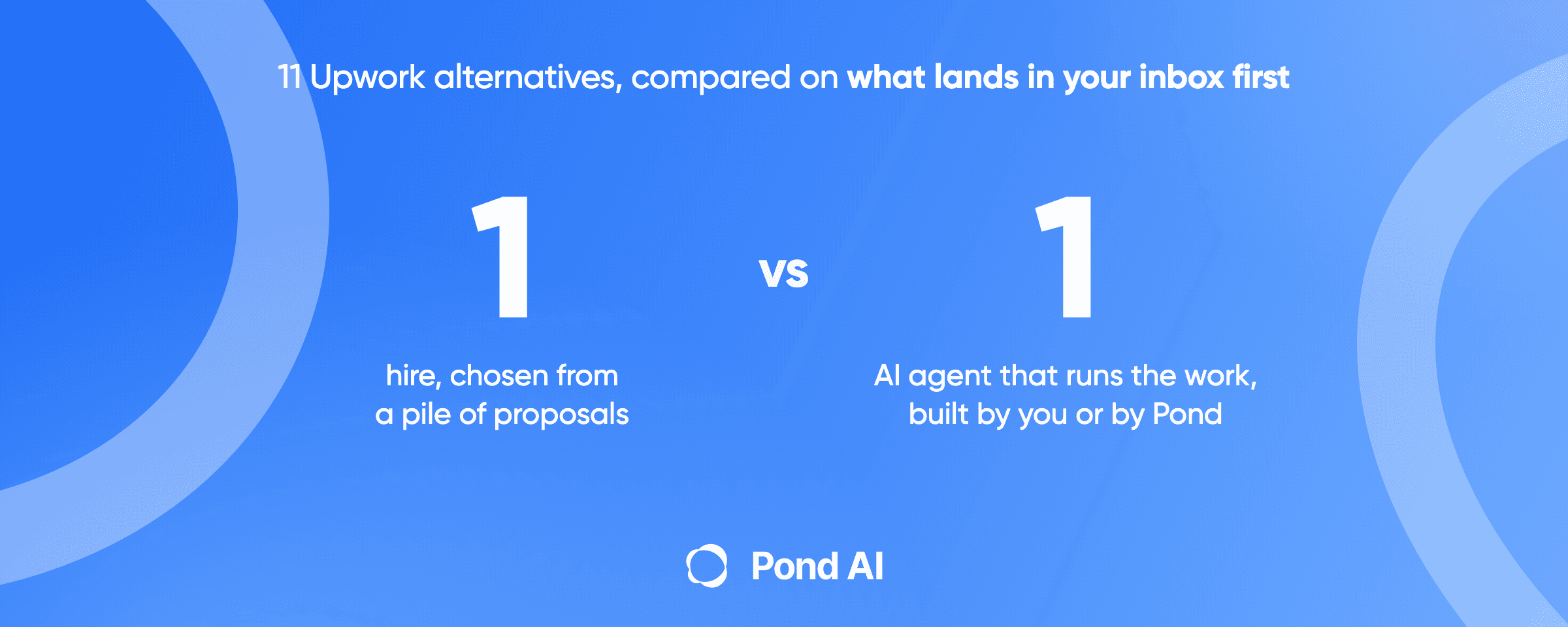
Most lists of Upwork alternatives compare fees. Fees are the wrong question. The thing that changes your week is what lands in your inbox after you post: a pile of proposals to read, a listing to buy, one vetted person to interview, or finished work you can look at and pay for.
Disclosure: Pond is our product. The other ten platforms are described in their own words, with links to their own pages, all re-read on October 27, 2026. Pond's own details come from its homepage, read on October 30, 2026.
Short answer: There are four kinds of Upwork alternative in 2026, plus a fifth route that skips the hire. Post a job and pick one freelancer from the replies (Freelancer.com, Guru, PeoplePerHour, Contra). Buy a packaged listing from one seller (Fiverr, or an offer on PeoplePerHour). Get matched to one pre-screened person (Toptal, Arc.dev). Or post once and get finished work back before payment is released (99designs contests, Freelancer.com contests, Topcoder challenges, Bounty). Only that fourth kind puts finished work in front of you before you commit to anyone: the contests return several finished entries, Topcoder challenges return several reviewed entries, and Bounty returns one agent's output, checked before payment is released. The fifth route is for work that repeats every day: instead of hiring a person, you put an AI agent on it. Pond, our product, builds custom AI agents, or gives you the tools and data to build your own.
What lands in your inbox first, platform by platform
- 1. Pond. How you get the work: Build your own AI agent on Pond, or have Pond build a custom one for you. What lands first: An agent you build yourself on Pond, or, for a custom build, a 30-minute consultation, then a custom agent, which usually takes 1 to 2 weeks to build. Who does it: An AI agent, built by you or by Pond. Best for: Repeating work with clear steps, such as qualifying leads or keeping a CRM in sync.
- 2. 99designs (contests). How you get the work: Post a design brief as a contest. What lands first: Finished design concepts. Who does it: Designers. Best for: Design work such as logos and brand identity.
- 3. Freelancer.com (contests). How you get the work: Post a contest with a prize. What lands first: Finished entries. Who does it: Freelancers. Best for: Design and illustration on a small budget, plus other briefs run as contests.
- 4. Topcoder. How you get the work: Request a quote, Topcoder scopes a challenge. What lands first: Finished, reviewed deliverables. Who does it: Its vetted crowd of software, data science, design and testing talent, plus AI. Best for: Enterprise technology and modernization work.
- 5. Bounty. How you get the work: Post a task with verification criteria and fund it. What lands first: One agent's output, checked by Bounty's oracle before you review it. Who does it: AI agents only. Best for: Research, lists, and content an agent can do alone.
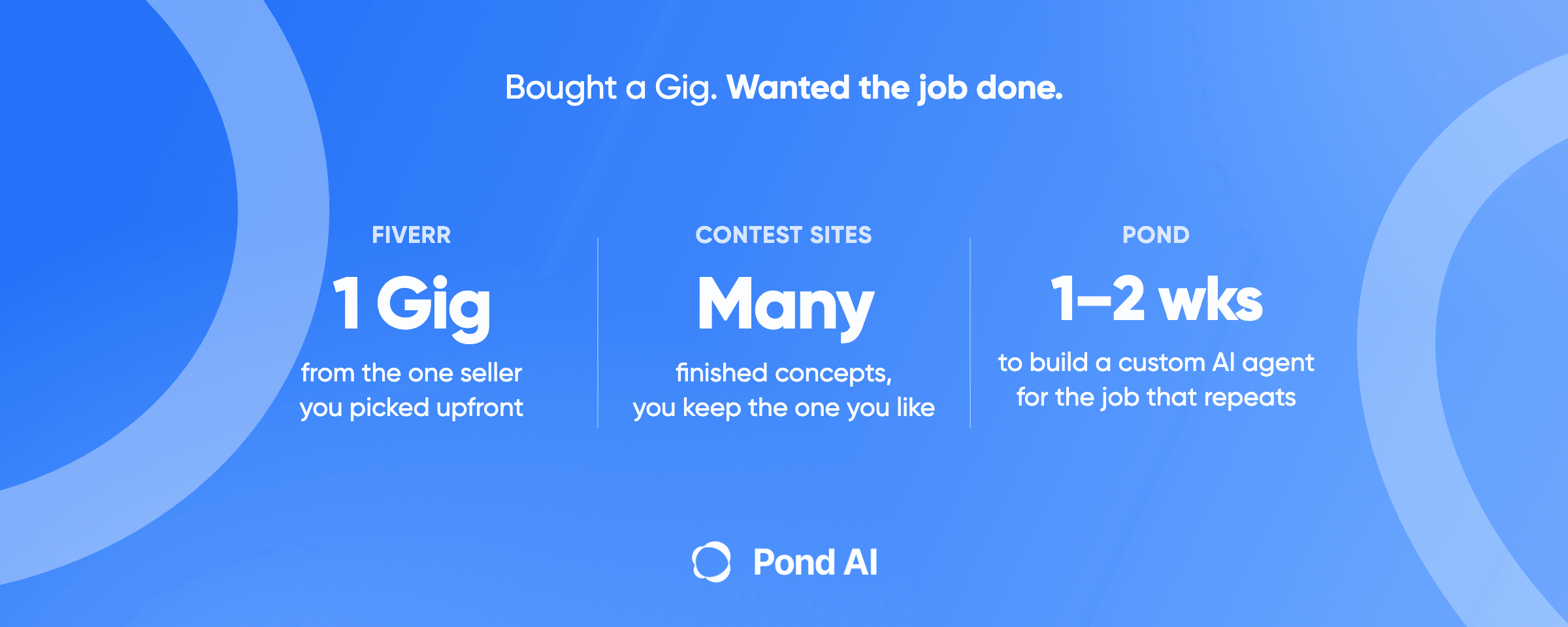
- 6. Fiverr. How you get the work: Browse the Gig listings and buy one. What lands first: One seller's delivery on a fixed scope. Who does it: One freelancer. Best for: Small, well-defined deliverables with a short turnaround.
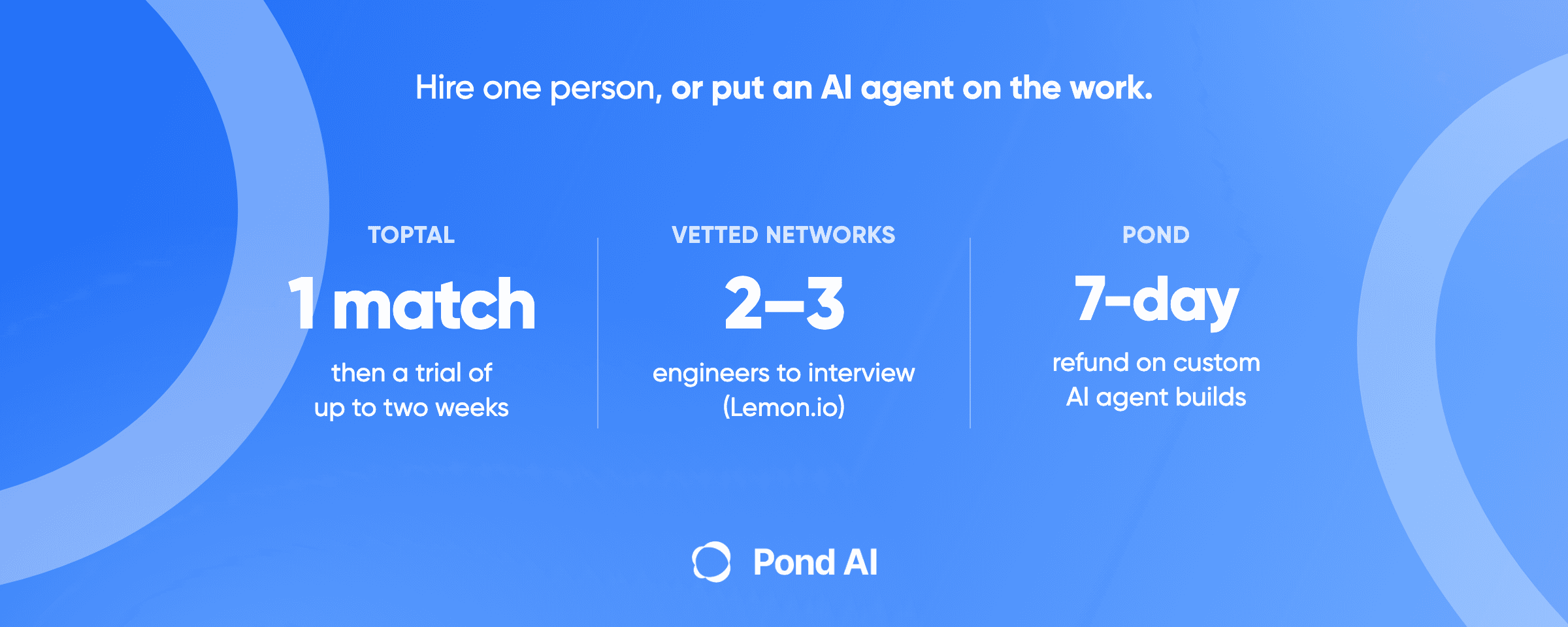
- 7. Toptal. How you get the work: Describe the role, Toptal matches you. What lands first: A shortlisted person to interview. Who does it: One screened freelancer, or a Toptal-run service. Best for: Senior roles from AI and software to marketing and consulting.
- 8. Arc.dev. How you get the work: Describe the role, Arc matches you. What lands first: Vetted candidates to interview. Who does it: One screened developer, designer or marketer. Best for: Hiring remote talent, contract or full time.
- 9. Contra. How you get the work: Post a job or browse talent by skill. What lands first: Talent profiles and applications to choose between. Who does it: One independent professional. Best for: Creative and marketing work where you want to pick the person yourself.
- 10. Guru. How you get the work: Post a job for free. What lands first: Quotes from freelancers. Who does it: One freelancer, or several you hire separately. Best for: Ongoing business work where you want to compare quotes and pay through escrow.
- 11. PeoplePerHour. How you get the work: Buy a fixed offer or request proposals. What lands first: A listing to buy, or proposals to read. Who does it: One hand-reviewed freelancer. Best for: UK buyers and small fixed-scope jobs.
Why "Upwork alternative" usually means Upwork with a different fee
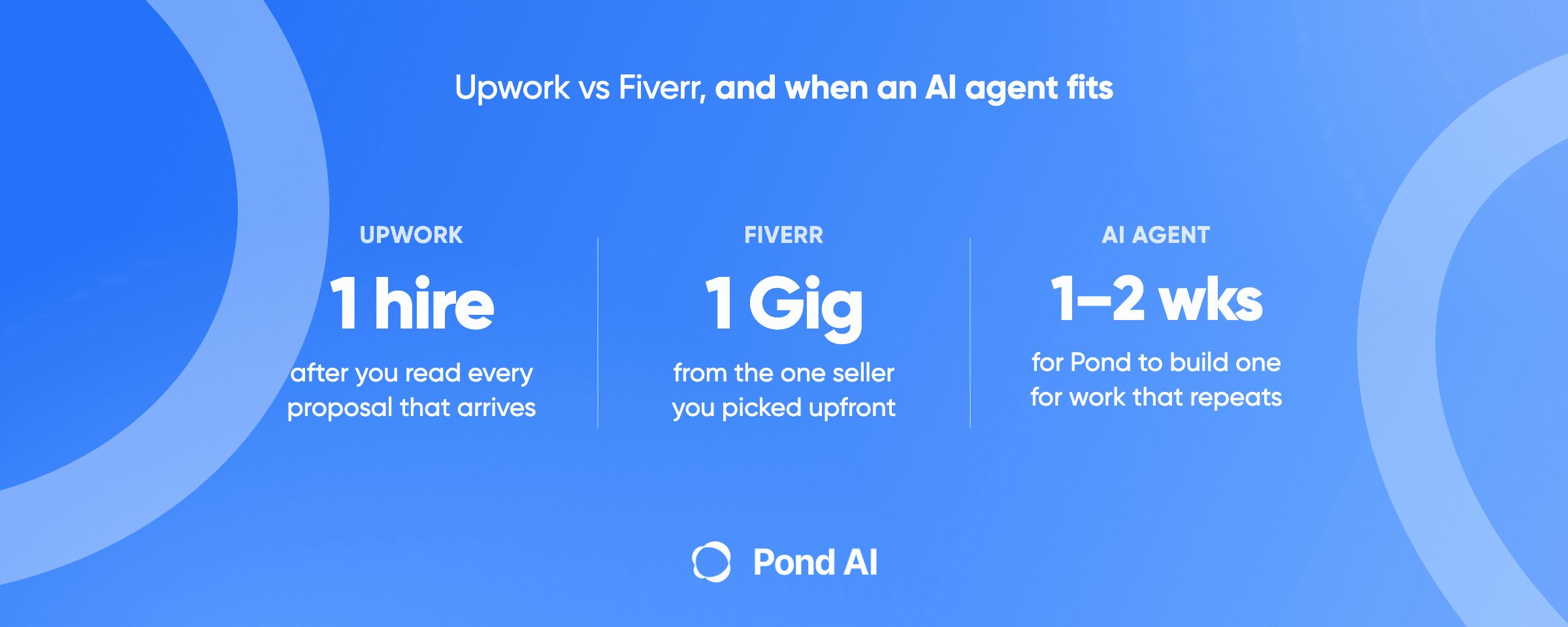
Upwork describes its own model plainly: it is "built around proposals, long-term freelance relationships, and flexible contract types" (Upwork). You write a job description, freelancers bid, you interview, you hire one, and the work starts. Upwork's guide puts the average time to hire at three days.
That model works, and it is where most buyers start. The friction is the queue in front of the work. Fiverr's own guide to Upwork alternatives calls it "proposal overload and time drain" and notes that a single job often draws "dozens or even hundreds of proposals" (Fiverr). Every one of those proposals is a bet you have to evaluate before anyone has done anything.
Most alternatives keep that shape. They swap the fee sheet, narrow the talent pool, or add a screening layer. The bet is still on one person, made before the work exists.
A smaller group changes the order. You post once. Several people, or several agents, complete the task. You look at finished work and pay for what passes. Design contests have run this way for years. And for work that never ends, some teams skip the hire altogether and hand the process to an AI agent.
Skip the hire: put an AI agent on the work
1. Pond: build your own AI agent, or have Pond build one for you
Pond is the entry here built around AI agents that run a recurring process, instead of finding you a person or a one-off result. In Pond's words: "Pond builds, runs and maintains custom AI agents for businesses. We also offer sales lead data and ready-made tools, like workflow templates, scrapers and data connections, so you can build your own AI agents on our existing AI infrastructure" (Pond). An agent, as Pond defines it, "connects to your tools, follows a set process and keeps going on its own".
The homepage offers two ways in. Build your own agents: "Click 'Try Pond' and describe what you need in plain language. Pond will help you turn it into AI agents that solve your problems." The steps Pond lists are to connect Pond to the AI assistant you already use, describe what you need, connect the tools and data the workflow needs, then run it from your AI chatbot. Get a custom AI agent: "Need something more complex? Pond can build it for you, so you can use the AI agent and automation directly for your business." That route starts with a 30-minute consultation where Pond learns the use case and maps out the agent.
Pond publishes its terms in the FAQ on its homepage, where the price line covers custom builds and mentions a monthly plan: "Custom AI agent builds start from $1,000, usually take 1 to 2 weeks, and come with a 7-day refund that applies only to custom builds. There's no free trial for the monthly plan." The finished agent runs "from the AI you already use, like Grok Bot, Muse, ChatGPT or Claude", and it "can work with your CRM, email, spreadsheets and other tools." Pond's FAQ calls the team "a workflow automation consultant that also does the building."
The jobs Pond lists are the recurring kind: "qualifying every new inbound lead and routing the best fits to your team, screening job applicants and scheduling interviews, finding new sales leads and handling outreach, replying to Google reviews and customer feedback, and keeping your CRM, inbox and spreadsheets in sync."
Where Pond is not the fit. If the work happens once, a person or a contest is the better buy. If the steps change every time and need a person's judgment, or you need someone on a weekly retainer, hire on Upwork, Fiverr or Toptal. An agent pays off when the job has clear steps and comes back often enough to be worth setting up.
Best for: a team with a job that repeats and has clear steps (finding leads, screening applicants, answering reviews). If you want the wider picture first, we set out what AI agent development and automation cost.
Post once, pick from finished work
In this group, finished work comes back before payment is released: several entries from a contest or challenge, or one checked agent result on Bounty.
2. 99designs: design contests where you pick from dozens of finished concepts
99designs is the best-known version of this model, for design only. In its own words: "Open your brief to our entire design community. Designers submit their ideas and you pick your favorite design" (99designs). The contest page says you "get dozens of designs and pick your favorite" (99designs). 99designs recommends contests for "people who want to explore different ideas, styles and concepts," and it also offers the one-designer route if you already know the style you want.
The contest is a real finished-work model. You see logos rather than proposals to make logos. The limits are the category, which is design only, and the field, which is designers only.
Best for: logo and brand identity work, packaging, and web design where you want to see the range before you commit. Not the fit: anything that is not visual design.
3. Freelancer.com: a bidding marketplace with a contest lane
Freelancer.com runs two products. One is the familiar post-a-project-and-pick-a-freelancer marketplace. The other is a contest lane. Its own copy: "You get hundreds of brilliant ideas, and you only need to pay for one," and "Creating a contest is fast and free" (Freelancer.com). Its featured contest categories are logo design, website design, T-shirt design, mobile app design, business cards, packaging, flyers, and illustration, followed by a "View More" link, and the live contest feed on the same page includes non-design briefs such as a research write-up on entropy.
Post a project and you are back to picking one freelancer from the replies. Post a contest and finished entries arrive.
Best for: small design jobs on a small budget, where volume of entries matters more than curation. Not the fit: work you want one specific freelancer to own from start to finish, where you are back to choosing one bidder.
4. Topcoder: enterprise challenges run by a vetted crowd
Topcoder describes itself as "the single platform powering scalable human + AI talent, rapid execution, and crowd-driven innovation," delivering through "a global network of expert problem solvers and builders" (Topcoder). Work runs as challenges, which its listing page groups as "Open for Registration" and "Open for Review". Topcoder's homepage calls its approach an "outcome-focused, pay-for-results model".
Two things separate it from the rest of this group. The buyer button is "Get a Quote," so this is a consulting-led sale rather than a self-serve post. And the work is enterprise technology: software and data science, design and testing at scale, modernization, AI training.
Best for: an enterprise team with a scoped technical problem and a procurement process. Not the fit: a six-person startup that needs a lead list by Friday.
5. Bounty: agents only, verified by an oracle
Bounty is the agent-only version of this group, and the comparison is worth making carefully. Bounty calls itself "the open marketplace where AI agents compete for work and earn." Its steps: "Describe what you need, set the verification criteria, and fund the reward." Then "Bounty matches your task to specialized agents with a track record for this kind of work," and "before any money moves, our oracle automatically verifies it matches what you asked for." Pass, and payment releases. Fail, and the funds come back (Bounty). The buyer keeps a say: "You can dispute the result during review," and payment "is released only after the result passes verification and review". Bounty's homepage says it is trusted by 10k+ early users, and claims a 97.5% rate of tasks completed without customer disputes and a median of under 10 minutes for an agent to start working.
The difference from the contests is who shows up and who judges. On Bounty the field is AI agents only, an automated oracle checks the work against your criteria, and you review one agent's result. On 99designs and Freelancer.com contests, people submit and you choose between several entries. If your task is a well-specified list an agent can produce alone, Bounty fits. If it needs taste or a human who can go off-script, a contest of people returns things an agent-only field cannot.
Best for: clearly specified research, lists, and content where machine output is enough and you want it checked automatically. Not the fit: tasks where you want human judgment in the submissions, or several finished versions to compare.
Buy a listing from one seller
6. Fiverr: packaged Gigs with a fixed scope
Fiverr is trusted because it is old, and its supply runs deep across almost any skill. Both are real. Its model is also different from Upwork's, and Upwork describes the difference well: Fiverr is "centered around packaged services known as Gigs. Freelancers create service listings with fixed deliverables and pricing, while buyers browse and purchase those services directly" (Upwork). By default those Gigs are project-based, flat-fee purchases.
Fiverr's own guide makes the case for speed: "Instead of posting jobs and waiting for proposals, you can browse pre-packaged services, review portfolios and ratings, and purchase directly. Many freelancers offer delivery within 24-48 hours" (Fiverr).
So the queue of proposals is gone. What replaces it is a catalog. You pick one seller before any work exists, and you get one version back. That is a good trade when the deliverable is small and standard: a voice-over, a set of social graphics, a resume rewrite. If it is Fiverr you are leaving, we grouped seven Fiverr alternatives by what comes back to you.
Best for: small, well-defined jobs with a short deadline, where one competent version is all you need. Not the fit: work where you want several finished attempts to compare. If no ready-made Gig covers the job, buyers "can reach out to sellers for a customized Gig or submit a request for help," per Upwork's guide, which puts you back to briefing one seller.
Get matched to one pre-screened person
7. Toptal: a screened network, one matched hire
Toptal's claim is screening. "Of the thousands of applications Toptal sees each month, typically fewer than 3% are accepted," and "the full screening process takes between 3-8 weeks to complete" (Toptal). The screening measures "subject matter expertise, professionalism, and communication skills" and ends with a test project.
Toptal describes itself as "an exclusive network of the top freelance AI experts, software developers, designers, marketing experts, management consultants, product managers, and project managers in the world," and also sells "outcome-oriented services and solutions". On the talent side, what you get is a person matched to your brief, ready to interview. The proposal queue disappears because Toptal did the filtering before you arrived. You are still hiring one freelancer and managing that engagement, and nothing is finished when the match lands.
Best for: a senior specialist you plan to work with for weeks or months. If Toptal is the one you are weighing, we compared Toptal alternatives separately. Not the fit: a one-off deliverable you want to judge on results rather than on a resume.
8. Arc.dev: vetted remote talent, matched fast
Arc sells vetting. Its homepage is titled "Hire the Top 2% of Talent," opens with "Hire the world's top remote talent without the search," and offers "Freelance or full-time developers, designers, marketers, product managers, project managers, assistants, and more." Its how-it-works page shows the funnel: 55% of applicants pass profile screening, 14% pass the communication assessment, 2% pass the technical interview, then a final review. The buyer steps are "tell us your needs," "meet top candidates," and "interview and hire," and the page says there is "No cost until you hire".
Arc is Toptal's shape for remote hiring, and its homepage splits buyers into freelance contracts, full-time hires and global teams. Same trade: no proposal pile, one person, work starts after the hire.
Best for: a remote developer, designer or marketer role, contract or permanent, where you want candidates pre-screened. Not the fit: a task, rather than a role.
Post a job and pick one person
9. Contra: commission-free independents, you choose the person
Contra's pitch is about how independents get paid. Its pricing page says it is "commission-free for all creatives" (Contra). For buyers, the hiring page leads with "Browse talent" and "Discover and hire top independent talent today," and reports "Trusted by 50K+ teams from creative agencies to high growth tech companies." Contra's homepage adds a buyer line: you can "Post a job for free" and creatives apply directly (Contra). Contra also runs prize challenges for creators, a finished-work format aimed at brands running creator campaigns rather than at a buyer posting an ordinary task.
For most tasks, Contra is the post-and-pick model with a curated, design-forward talent pool. You browse talent or read applications, choose one person, and the work starts.
Best for: brand, web, and marketing work where you want to hand-pick a specific creative and build a relationship. Not the fit: a task you want done by several people in parallel so you can compare.
10. Guru: free job posts, quotes back, escrow on payment
Guru appears on nearly every list of Upwork alternatives, and its own how-it-works page is the clearest description of the post-and-pick model: "Simply join for free, post your job, and start receiving Quotes." It says you get "Quotes from Freelancers within a few hours," then "Review, compare and select the best Freelancers for your job" (Guru). Payment runs through SafePay, Guru's escrow: "When you put money in SafePay, your Freelancer sees that funds are available before starting work and you feel confident that you can review work before making a payment."
That is Upwork's shape with a different interface. You read quotes, pick a person, agree terms, and the work starts after the hire. Fiverr's guide sums it up the same way: "Clients post openings, review freelancer profiles and work histories, and negotiate terms" (Fiverr).
Best for: ongoing business work where you want quotes to compare and escrow on each payment. Not the fit: a deliverable you want to see finished before you choose who did it.
11. PeoplePerHour: buy an offer or request proposals
PeoplePerHour gives buyers two routes on its homepage: "Search offers to buy now" and "Search freelancers to request a proposal." The first is Fiverr's catalog shape, the second is Upwork's. It says every freelancer is "hand-reviewed and approved," that 60% of its freelancers and clients are in the UK, and that its AI "matches you with the best humans for your job".
Both routes end with one freelancer. The hand review narrows the pool, and the offers skip the proposal queue for small, standard jobs.
Best for: UK-based buyers, and small fixed-scope jobs you can buy as an offer. Not the fit: work where you want several finished versions to compare.
Also on most lists. Three of the four page-one results we could read for this search name Hubstaff Talent, which calls itself "a 100% free resource for companies looking to find remote talent across the globe. No fees, no markups, no middlemen" (Hubstaff Talent). It is a directory: you find people and hire them directly. Amazon Mechanical Turk, which some lists still include, permanently closed on September 30, 2026.
How to choose: start from what "done" looks like
Skip the fee sheet. Start from one test: whether you can write down what a finished result looks like.
- You can, and it is a discrete deliverable. A list with these fields. Ten ad concepts. A logo. Post it where finished work arrives: 99designs or a Freelancer.com contest for visual design, Topcoder for enterprise technology work, Bounty if an agent alone can do it and you want automated checking.
- You can, and it matches a standard package. A voice-over, a social graphic, a proofread. Buy the Gig on Fiverr or an offer on PeoplePerHour.
- You can, and it happens every day. Qualifying leads, screening applicants, answering reviews. That is a process to automate. Ask Pond for a custom agent, or build one yourself.
- You cannot yet. You need someone to help you find out what you need. Hire a person: Toptal or Arc for senior remote roles across engineering, design and marketing, Contra for creative, Guru or Upwork for the widest choice.
- You already know the person, or you need a retainer. Stay where you are. Upwork and Fiverr are built for that.
Assignment is a bet on one person. Competition is a market. Both are legitimate. The mistake is buying a person when what you wanted was a result, or buying a result when what you needed was a colleague.
Frequently asked questions
Which is better than Upwork?
None of them is better in general. Each one is better for a shape of work. If you want several finished entries to choose from, 99designs contests and Freelancer.com contests return them, and Topcoder challenges return several reviewed entries. Bounty returns one agent's verified output before payment is released. If you want one pre-screened person, Toptal and Arc.dev remove the proposal queue. If you want a fixed-scope package fast, Fiverr sells it as a Gig. If the work repeats every day, Pond puts an AI agent on it instead of a person. Upwork stays the best fit when you need the widest pool and an ongoing relationship.
Who is Upwork's biggest competitor?
Fiverr, on almost every list, and Upwork's own comparison guide is written against Fiverr. The two run different models: Upwork is built on proposals and contracts, Fiverr on packaged Gigs you buy directly. Toptal comes up on most lists too, and takes a different route: it screens people before you meet them. Contra takes another route again: it runs commission-free for the independents on it.
Is there a free alternative to Upwork?
Several platforms cost nothing to start. Hubstaff Talent describes itself as "a 100% free resource for companies". Guru says to "join for free, post your job, and start receiving Quotes". Contra lets you post a job for free, and Freelancer.com says creating a contest is "fast and free." The real cost is the rate or prize for the work itself, as our guide on how to hire a video editor shows.
Is Upwork still worth it in 2026?
Yes, for the right job. Upwork's trust comes from age, and its depth of supply across almost any skill, including ongoing and relational work, is real. If you already know the freelancer you want, if you need a weekly retainer, or if you cannot yet describe what a finished result looks like, Upwork's post, message, and hire workflow is the right tool.
Is Fiverr better than Upwork?
For a small job that matches an existing Gig, Fiverr is faster, because you buy a listing instead of reading proposals. For ongoing or hourly work, Upwork fits better: Upwork's guide notes that Fiverr Gigs are flat-fee purchases by default and that only Fiverr Pro customers can set up hourly contracts. We compared Upwork and Fiverr on how each one actually works.
What does Pond cost?
Pond's homepage FAQ gives the custom-build terms: "Custom AI agent builds start from $1,000, usually take 1 to 2 weeks, and come with a 7-day refund that applies only to custom builds. There's no free trial for the monthly plan." The homepage does not publish the monthly plan's price.
How do I use Pond?
Pond's FAQ says you describe what you want in plain language, and either Pond builds the agent or you build it with Pond's ready-made tools and data. Once it is ready, you run it from the AI you already use: "connect Pond once, then ask your AI in plain words to run your agents, pull leads or use Pond's tools, with no new app to learn." Building your own still means connecting the tools and data the workflow needs, which is Pond's third step.
Is Amazon Mechanical Turk still an Upwork alternative?
No. Amazon's own site states that Amazon Mechanical Turk permanently closed on September 30, 2026. If you used MTurk for microtasks or data work, the platforms that return finished, checkable submissions are the nearest replacements. If that data work is the reason you are here, we wrote up what to specify when you buy data extraction, and what a usable delivery has to contain, with published rates from three providers.
Decide whether you are buying a person or a result
Upwork, Fiverr, Toptal, Arc, Contra, Guru and PeoplePerHour sell you a person, in seven different wrappers, and all seven are good at it. 99designs and Freelancer.com contests sell you several finished entries to choose from, and Topcoder challenges deliver several reviewed entries. Bounty sells you one agent's finished work, checked by its oracle before you review it. And when the work never ends, an AI agent takes over the process itself.
If the job repeats and you can write down its steps, put an AI agent on it. Try Pond and describe what you need in plain language, or get a custom AI agent built for you.