Short answer
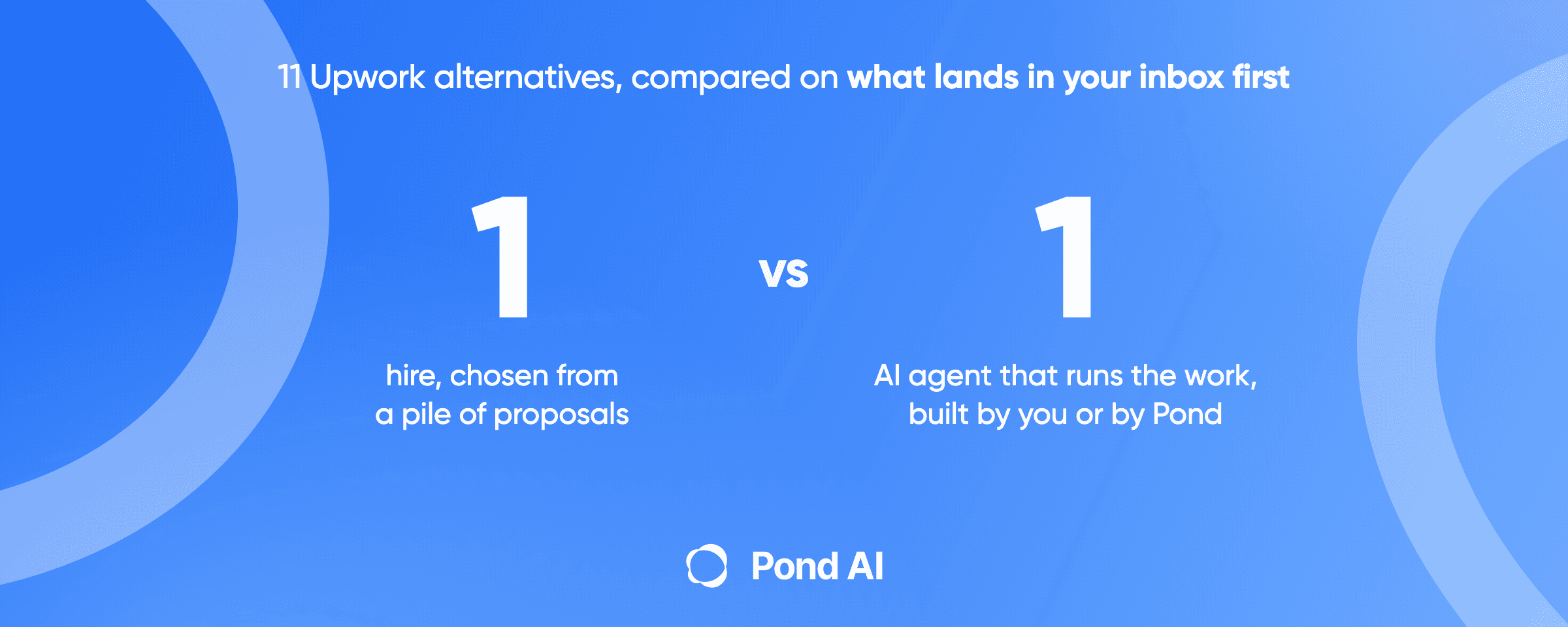
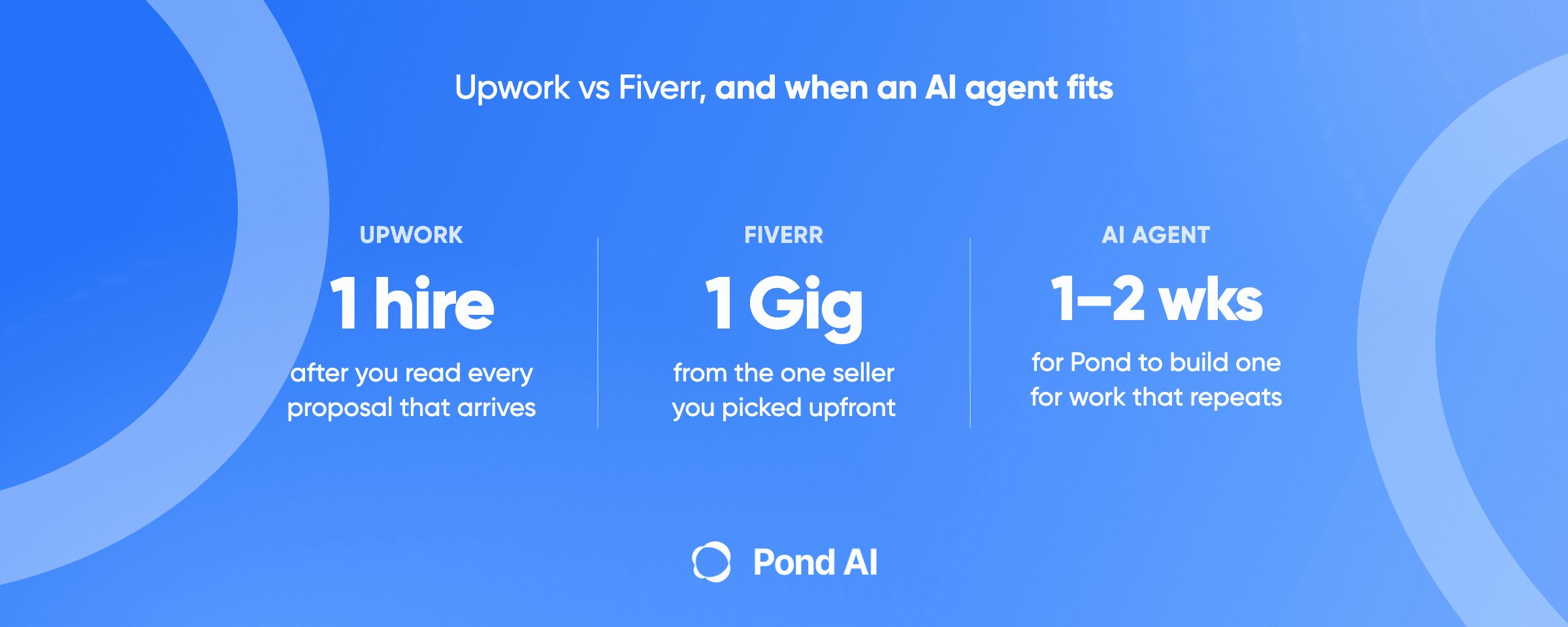
Upwork and Fiverr are not really the same product. On Upwork you post a job, freelancers send proposals, and you pick one and manage them. On Fiverr you browse packaged Gigs, buy one, and wait for delivery. Upwork suits work that will evolve. Fiverr suits work you can define in a sentence. Both end the same way: one person doing the job, and you finding out whether that bet paid off. For work that repeats every day, there is a different route: instead of hiring a person, you put an AI agent on it. Pond, our product, builds custom AI agents, or gives you the tools and data to build your own.
Disclosure: this is Pond's blog, and Pond appears below as a different route for work that repeats. Every fact about how Upwork and Fiverr work comes from their own help pages and investor filings, linked, read between 9 and 11 September 2026. Pond's details come from its homepage, read on 30 October 2026. This piece does not compare Upwork and Fiverr on price, because price is not what separates them.
Choose Upwork if, choose Fiverr if, choose an AI agent if
Choose Upwork if the scope will move. Hourly contracts, weekly time tracking and funded milestones exist for work that cannot be fully specified on day one. Its fixed-price dispute path can also end in a binding decision from a neutral arbitrator, which is a stronger remedy than a cancellation and a refund. If you want a person you can brief, correct and keep, this is the one.
Choose Fiverr if you can write the job in one line and want it ordered today. Packaged Gigs are comparable and buyable without a briefing call, and you can filter sellers by delivery time before you pay. If the deliverable is a logo, a 60-second edit or a landing page, browsing beats posting.
Choose an AI agent if the job is not a one-off but a process that comes back every day with the same steps, such as qualifying new leads, screening job applicants or keeping a CRM in sync. Pond, our product, offers two ways in: build your own agents with Pond's ready-made tools and data, or have Pond build a custom AI agent for you. More on that below.
Choose none of them if the work is a relationship rather than a deliverable. More on that at the end, because it is the honest half of this comparison.
How each one actually works
The mechanic is the real difference, so here it is side by side, from each platform's own documentation.
Finding someone. Upwork gives you both doors: "you can either post a job for freelancers to apply to or go straight to talent search if you already know the skills, role, or person you want to hire." Fiverr is browse-first, but not browse-only. You can search and filter Gigs, or "post a project brief to receive tailored offers from relevant freelancers."
What arrives first. On Upwork, proposals. Its own guide says "proposals will start coming in within hours." On Fiverr, nothing arrives until you order, because the offer already exists as a package.
When you pay. Upwork fixed-price runs on funded milestones. You "deposit funds (minimum $5.00 USD per milestone)" and "work is submitted for your approval before funds are released." Fiverr collects at checkout: you "confirm your payment method and click Confirm & Pay," and the freelancer is paid once you accept the delivery, or automatically if you do nothing for 72 hours.
What you end up with. One contracted freelancer on Upwork. One ordered Gig on Fiverr.
How Upwork works, in more detail
Upwork's own 2026 hiring guide describes five steps: sign up, post a job or search for talent, shortlist candidates, run interviews, and send an offer. Both routes stay open the whole way, and you can invite people directly from search instead of waiting for proposals to arrive.
Its AI now sits inside that flow. Upwork says "more than 70% of new clients use Uma's Job Post Generator to draft a clear job post in seconds," and that Uma "can also curate shortlists in as little as six hours" on its Business Plus tier.
Contract types map to how settled the work is. Upwork's own guidance: "use hourly when the work is ongoing or likely to evolve. Use fixed-price when the deliverables and milestones are clearly defined. Hourly work is billed weekly, while fixed-price work uses funded milestones." For video editing, we set those two contract types next to monthly editing subscriptions in hiring a video editor: hourly or a monthly subscription.
Upwork's dispute process is the more developed of the two, and it deserves to be described properly rather than waved at. On fixed-price contracts, per Upwork's own dispute guide, "Upwork's disputes team first provides a nonbinding recommendation. If either party still disagrees, they can choose to move to binding arbitration, handled by a neutral third party." Arbitration must be requested within seven days of the notice of nonresolution, "the arbitration fee is usually split evenly between the client and freelancer," and "the process typically wraps in about 30 days, and the decision is binding." On hourly contracts the test is the Work Diary, decisions are final, and Hourly Payment Protection carries "a lifetime cap of $2,500 per client or 50 hours at your average rate, whichever is lower."
Vetting is worth reading carefully. Upwork verifies identity for real: a government photo ID plus a "short video call or phone photo to confirm the person in your ID matches your profile photo," and most users are "verified within minutes." That is fraud verification rather than skill verification. Skill screening is a paid tier: hiring "from the top 1% of freelancers and agencies who are rigorously screened for both technical expertise and soft skills" is a Business Plus feature, and a Basic-plan client does not get it.
On speed, Upwork does not publish one authoritative number, and it would be wrong to invent one. Its own guide says "most active clients find the right freelancer within days" and that typical clients "go from job post to signed contract in just a few days."
How Fiverr works, in more detail
Fiverr's own description: "freelancers offer their services through Gigs, where you can browse their skills, packages, and reviews before placing an order." Most sellers publish Basic, Standard and Premium packages, and "each package outlines what is included and at what price." You can filter by delivery time before ordering, or request a custom offer instead of taking a package as listed.
There is a gate on some listings. "On some Gigs, a freelancer may require you to send a Request to Order before you can place your order," which exists so the seller can check the requirements first. Repeat clients can often skip it.
After delivery, your options are narrow and clear: "accept the delivery, request revisions, or request more time." Fiverr's own advice is blunt: "don't complete an order unless you are satisfied with the delivery." If you do nothing, the order completes itself after 72 hours and the seller is paid.
Fiverr does have a formal dispute route. A buyer opens the Resolution Center from the order page, and an order in that state carries a Dispute status. What it does not end in is an Upwork-style binding decision from a neutral arbitrator. The remedy is cancellation and refund. Fiverr discourages a bank chargeback instead, saying "filing a dispute goes against our Payment Terms," and directs buyers to their own payment provider first. A processed refund can take "up to 10 days" to appear.
Fiverr's vetting is the opposite shape to Upwork's, and it is genuinely clever. Sellers are scored continuously on six metrics, Success Score, rating, response rate, orders, unique clients and earnings, and those scores decide their level. Level 1 needs a 5-plus Success Score, a 4.4-plus rating, an 80% response rate, 5 orders, 3 unique clients and $400 earned. Level 2 raises it to 7-plus, 4.6-plus, 90%, 20 orders, 10 clients and $2,000. Top Rated needs 9-plus, 4.7-plus, 90%, 40 orders, 20 clients and $10,000, plus a human pass: "all Top Rated freelancers are individually reviewed and approved by Fiverr's evaluation team." If any metric drops, a 30-day grace period starts. A Fiverr level is a live signal rather than a certificate from three years ago.
Fiverr publishes no hiring-time figure, and the delivery times on a Gig are not the same thing as time-to-hire. Do not let anyone sell you the two as one number.
Both are much bigger than the internet suggests
Upwork's and Fiverr's own public filings show two platforms that are still enormous, and that scale is real whatever anyone says about the experience of using them.
In its Form 10-Q for the quarter ended 30 June 2026, Upwork reported gross services volume of $966.4 million, down 4% year on year, and active clients down 4% to 763,000, with spend per active client up 5% to $5,230. Revenue was $191.7 million, a 2% decrease. Its own marketing page claims "18+ million freelancers across 180 countries."
In its second-quarter results for 2026, Fiverr reported 2.7 million annual active buyers, down from 3.4 million a year earlier, with annual spend per buyer up 15.6% to $368. Revenue was $97.8 million against $108.6 million. Its About page lists "over 700 skills" across an estimated 160 countries, from a company founded in 2010.
Read those together and two things are true at once. Both platforms are shrinking in buyer count and growing in spend per buyer, which is what a maturing marketplace looks like. And both are still enormous, with supply depth across almost any skill that no newer marketplace matches. Their trust is earned by being old, and that is not worth arguing with.
What buyers actually complain about
The complaints are specific, and they are not about price. They are about the shape of the bet.
On Upwork, the friction is volume. A widely shared post about posting an Upwork job puts it this way: "I recently posted a job and got 50+ proposals in just 30 minutes." Proposals arriving within hours is Upwork's own selling point, and it is also the work. Fifty pitches is a shortlisting job you did not plan to do, before anybody has produced anything.
On Fiverr, the friction is the single hire. A founder on r/startups put it as: "Is fiverr dead? The freelancers there suck. I had a bad experience of hiring some who gave me a bad website." You pick one seller, get one shot at the output, and if it is wrong, a week disappears. A high-spend buyer in r/Fiverr opened a thread with "I'm a Fiverr buyer, I've spent nearly $50,000 over my time," which is not the sentence of someone who dislikes the platform. It is the sentence of someone who has hit its limit. If that is where you are, we sorted Fiverr alternatives by what each one hands back after you pay.
These threads are quoted from their indexed page text and were not readable in full when we checked, so treat them as illustrative rather than representative.
Both complaints point at the same structural fact. Assignment is a bet on one person. You can shortlist carefully, read every review, and still get one version of the work at the end.
A different route for work that repeats: an AI agent
Upwork and Fiverr both sell you a person, and for one-off work that bet is usually worth making. When the job comes back every day with the same steps, some teams skip the hire and put an AI agent on it. Pond, our product, works that way. In Pond's words: "Pond builds, runs and maintains custom AI agents for businesses. We also offer sales lead data and ready-made tools, like workflow templates, scrapers and data connections, so you can build your own AI agents on our existing AI infrastructure" (Pond). An agent, as Pond defines it, "connects to your tools, follows a set process and keeps going on its own".
The homepage offers two ways in. Build your own agents: "Click 'Try Pond' and describe what you need in plain language. Pond will help you turn it into AI agents that solve your problems." The steps Pond lists are to connect Pond to the AI assistant you already use, describe what you need, connect the tools and data the workflow needs, then run it from your AI chatbot. Get a custom AI agent: "Need something more complex? Pond can build it for you, so you can use the AI agent and automation directly for your business." That route starts with a 30-minute consultation where Pond learns the use case and maps out the agent.
For a custom build, Pond's homepage FAQ says builds "start from $1,000, usually take 1 to 2 weeks, and come with a 7-day refund that applies only to custom builds." The finished agent runs "from the AI you already use, like Grok Bot, Muse, ChatGPT or Claude", and it "can work with your CRM, email, spreadsheets and other tools."
The jobs Pond lists are the recurring kind: "qualifying every new inbound lead and routing the best fits to your team, screening job applicants and scheduling interviews, finding new sales leads and handling outreach, replying to Google reviews and customer feedback, and keeping your CRM, inbox and spreadsheets in sync." That is the shape where an agent pays off: the job repeats and has clear steps.
If you want more options than Upwork and Fiverr, we compared ten platforms, plus Pond's AI-agent route, in Upwork alternatives.
When to stay with a person instead
This is the part most comparison pages leave out, and it decides whether the rest of the page is trustworthy.
Stay on Upwork or Fiverr when you already know the person and want to keep working with them. Stay when you need a weekly retainer rather than a discrete deliverable. Stay when the work happens once, or when the steps change every time and need a person's judgment, because an agent pays off when the job repeats and its steps can be written down.
An AI agent is also the wrong buy for a single deliverable, such as a logo or a 60-second edit. Setting one up is worth it when the same work comes back often enough to repay the effort.
And the skeptic's version deserves an answer rather than a dodge: if you already use ChatGPT or Claude, why add anything? Pond's homepage FAQ answers it this way: out of the box, those assistants "aren't connected to your CRM, inbox or data, and they don't run your process every day on their own." With Pond connected, you run the agent from the assistant you already use, with no new app to learn, and you review the results.
Frequently asked questions
Is Fiverr better than Upwork?
Neither is better in general, and the honest answer depends on how settled the work is. Upwork is stronger when the scope will evolve: hourly contracts billed weekly, funded milestones, and a dispute path that ends in binding arbitration. Fiverr is stronger when the deliverable is already defined, because you can compare packaged Gigs, filter by delivery time and order without a briefing call.
Which is easier for beginners?
Fiverr, for a first-time buyer. Browsing, picking a package and paying happen in one visible flow you can see through before you commit. Upwork asks you to write a job post, read proposals, interview and structure a contract, which is more control and more work. Upwork does say more than 70% of new clients now use its AI to draft the job post.
Which is better for long-term work?
Upwork. Hourly contracts with weekly billing and time tracking exist for ongoing work, and its own guidance is to use hourly "when the work is ongoing or likely to evolve." Fiverr's Gig structure is built around a defined order with a delivery date, so a long relationship there means placing repeat orders rather than running a contract.
When does the freelancer get paid on each platform?
On Upwork fixed-price contracts you deposit funds into a milestone before work starts, and "work is submitted for your approval before funds are released." On Fiverr you pay at checkout and the seller receives the money once you accept the delivery, or automatically if you take no action for 72 hours. Both hold your money until delivery is accepted. Fiverr just collects it earlier in the sequence.
What happens if the work is bad?
On Upwork you can ask for changes or request a refund, and if you and the freelancer cannot agree, the disputes team issues a nonbinding recommendation that either side can escalate to binding arbitration within seven days. On Fiverr you accept, request revisions, or request more time, and you can open a dispute in its Resolution Center. If that fails the route is cancellation and a refund that can take up to 10 days. Fiverr also says filing a chargeback with your bank or PayPal goes against its Payment Terms, and asks you to settle that with your payment provider before its support team picks the case back up.
How long does it take to hire on Upwork or Fiverr?
Neither publishes a firm figure, and anyone who quotes you one is estimating. Upwork says most active clients find someone "within days" and that typical clients go from job post to signed contract in "a few days." Fiverr publishes no hiring-time figure at all. The delivery times shown on a Gig describe how long the work takes after you order, rather than how long choosing takes.
Where does Pond fit against Upwork and Fiverr?
Pond is not a place to find a freelancer. It is a different route for work that repeats: you put an AI agent on the process instead of hiring a person for it. You can build your own agents with Pond's ready-made tools and data, or have Pond build a custom AI agent for you, starting with a 30-minute consultation. Upwork and Fiverr both end with one person doing the job. With an agent, the same steps run each time, and you review the results.
What does Pond cost?
Pond's homepage FAQ gives the custom-build terms: "Custom AI agent builds start from $1,000, usually take 1 to 2 weeks, and come with a 7-day refund that applies only to custom builds. There's no free trial for the monthly plan." The homepage mentions a monthly plan but publishes no price for it.
How do I use Pond?
Pond's homepage FAQ says you describe what you want in plain language, and either Pond builds the agent or you build it with Pond's ready-made tools and data. Once it is ready, you run it from the AI you already use: "connect Pond once, then ask your AI in plain words to run your agents, pull leads or use Pond's tools, with no new app to learn." Building your own still means connecting the tools and data the workflow needs, which is Pond's third step.
Should I use Upwork, Fiverr and Pond together?
Many teams should. Keep a retained freelancer on Upwork for the work that never finishes, use Fiverr for the small defined jobs you can describe in a line, and put an AI agent on the process that repeats every day with the same steps. They are three different shapes of purchase, rather than three vendors selling the same thing.
Decide what you are buying, then pick the platform
The question in the search box is which platform is better. The more useful question is what you want to end up holding. If that is a file of data, the question has a specific answer, and it starts with the spec you hand any provider. If it is a working agent or an automation, the answer has the same shape: what AI agent development and automation cost, and the spec that makes quotes comparable.
If you want a person, Upwork and Fiverr are the two best-known ways to get one, and their scale and buyer protections are real. If the job repeats every day and you can write down its steps, put an AI agent on it: Try Pond and describe what you need in plain language, or get a custom AI agent built for you.